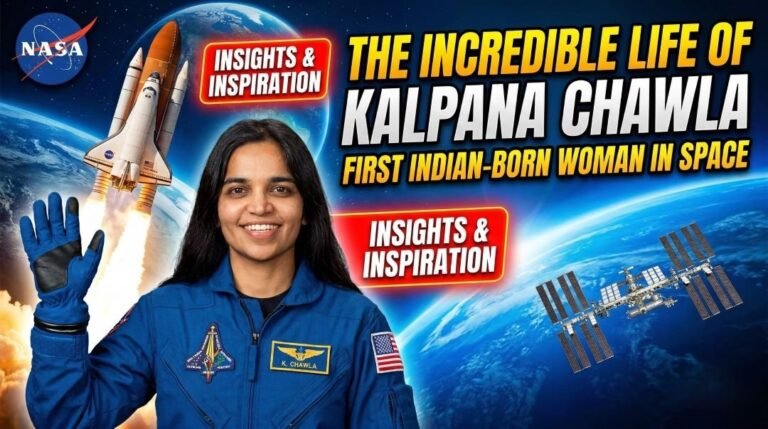
In this article we will discuss about the Kalpana Chawla Biography PDF and PPT Download, Kalpana Chawla Biography, Death, Story, Husband, Education, Achievements and Complete Legacy so, On the morning of 1 February 2003, the world watched in horror as the Space Shuttle Columbia broke apart over the skies of Texas, just sixteen minutes before it was due to land. Among the seven crew members who lost their lives that morning was Kalpana Chawla – a woman who had grown up in Karnal, a small city in Haryana, dreamed of the stars since childhood, built an extraordinary career in aerospace engineering, and had already made history in 1997 as the first woman of Indian origin to go to space. She was 40 years old.
Kalpana Chawla’s story is one of the most remarkable in Indian history – a story of a girl from a conservative North Indian family who defied every convention of her time and place, pursued an education in engineering when few women did, moved to the United States alone to pursue postgraduate study, earned a PhD in aerospace engineering, joined NASA, flew in space twice, and became a permanent symbol of possibility for millions of Indian girls and women who came after her.
This comprehensive article covers everything about Kalpana Chawla – her biography in English and in Hindi, her story, death and how she died, husband, in space achievements, education, parents (mother Sanjyothi Chawla and father Banarasi Lal Chawla), children, awards won, born date and place, and full CTET/EVS reference for students and teachers.
Kalpana Chawla: Complete Biography Table
The following table provides a comprehensive, at-a-glance biography of Kalpana Chawla – every essential fact from her birth to her death and her legacy:
| Biographical Detail | Information |
| Full Name | Kalpana Chawla |
| Date of Birth | 17 March 1962 (some sources cite 1 July 1961 – the 1962 date is officially accepted) |
| Born Place | Karnal, Haryana, India |
| Date of Death | 1 February 2003 |
| Death Age | 40 years old |
| Cause of Death | Space Shuttle Columbia disaster – the shuttle disintegrated during re-entry into Earth’s atmosphere on 1 February 2003, killing all seven crew members |
| How Did She Die? | The Space Shuttle Columbia broke apart during re-entry into Earth’s atmosphere over Texas and Louisiana on 1 February 2003 – approximately 16 minutes before the scheduled landing. The cause was damage to the thermal protection system sustained during launch when a piece of foam insulation struck the leading edge of the left wing. |
| Nationality | Indian-American; born Indian; became a naturalised United States citizen in 1991 |
| Father’s Name | Banarasi Lal Chawla |
| Mother’s Name | Sanjyothi Chawla (also spelled Sanjyoti) |
| Siblings | Three siblings – two brothers (Sanjay Chawla, Deepak Chawla) and one sister (Sunita Chawla). Note: Sunita Chawla is her sister, not Sunita Williams. |
| Husband | Jean-Pierre Harrison – a flying instructor and aviation writer; she married him in 1983 |
| Children | Kalpana Chawla had no children |
| Does Kalpana Chawla Have a Child? | No – Kalpana Chawla did not have any children. She was focused entirely on her career in aerospace engineering and NASA. |
| Education – School | Tagore Baal Niketan Senior Secondary School, Karnal, Haryana |
| Education – Bachelor’s Degree | Bachelor of Engineering (Aeronautical Engineering) – Punjab Engineering College (PEC), Chandigarh, 1982 |
| Education – Master’s Degree | Master of Science in Aerospace Engineering – University of Texas at Arlington, USA, 1984 |
| Education – PhD | PhD in Aerospace Engineering – University of Colorado Boulder, USA, 1988 |
| NASA Career Start | Joined NASA Ames Research Center in 1988 as a researcher in computational fluid dynamics |
| Selected for NASA Astronaut Corps | March 1995 – selected for the NASA astronaut programme |
| First Space Mission | STS-87 (Space Shuttle Columbia) – launched 19 November 1997; she was the mission specialist and primary robotic arm operator; logged 376 hours in space; first woman of Indian origin to go to space |
| Second Space Mission | STS-107 (Space Shuttle Columbia) – launched 16 January 2003; mission duration 15 days 22 hours 20 minutes; ended in the Columbia disaster on 1 February 2003 |
| Total Time in Space | Approximately 30 days, 14 hours, 54 minutes across both missions |
| Which Astronaut Spent 322 Days in Space? | This refers to Sunita Williams (not Kalpana Chawla). Sunita Williams spent 322 days in space across her missions. Kalpana Chawla is a different person – Sunita Williams is an American astronaut of Indian descent; Kalpana Chawla was the first woman of Indian origin in space. |
| In Space – Key Achievements | First woman of Indian origin to go to space; operated the robotic arm to deploy and retrieve the Spartan satellite (STS-87); conducted experiments in microgravity; first Indian-American woman in space |
| Awards and Achievements | Congressional Space Medal of Honor (posthumous); NASA Space Flight Medal; NASA Distinguished Service Medal; Karnataka Rajyotsava Award; India’s Padma Vibhushan (posthumous); numerous educational institutions, roads, and awards named after her |
| Legacy – Named After Her | NASA satellite named after her; Punjab Engineering College girls’ hostel named after her; University of Texas Arlington department named after her; Karnataka government’s Kalpana Chawla Award for women scientists; many schools, roads, and institutions across India and the USA bear her name |
Kalpana Chawla Biography PDF and PPT Download (PPT SLIDES)
Kalpana Chawla Story: Who Is She and Why Is She Famous?
Kalpana Chawla was born on 17 March 1962 in Karnal, a city in Haryana, India. She was the youngest of four children of Banarasi Lal Chawla – a businessman – and Sanjyothi Chawla. From her earliest years, she was fascinated by aircraft and flying – she would later recall watching small planes take off from a local flying club near Karnal with her father and feeling, with absolute certainty, that she wanted to fly.
In the Haryana of the 1960s and 70s, this was not a conventional ambition for a girl. But Kalpana Chawla was not a conventional person. She pursued her interest in engineering against the expectations of a society that directed girls towards more traditional paths. She enrolled in aeronautical engineering at Punjab Engineering College in Chandigarh – one of the most competitive engineering institutions in India – and graduated in 1982. She then did something that required extraordinary courage: she left India alone to pursue a Master’s degree in aerospace engineering at the University of Texas at Arlington. She was a young woman from Haryana, in Texas, pursuing a postgraduate degree in one of the most demanding fields of engineering. She never looked back.
She earned her Master’s in 1984, a second Master’s in 1986, and a PhD in aerospace engineering from the University of Colorado Boulder in 1988. She joined NASA Ames Research Center as a researcher. She married her husband Jean-Pierre Harrison in 1983. She became a US citizen in 1991. She was selected for the NASA astronaut programme in March 1995 – one of 15 selected from nearly 3,000 applicants. And on 19 November 1997, she launched into space aboard the Space Shuttle Columbia, becoming the first woman of Indian origin to leave the Earth’s atmosphere. Millions of Indians watched. The girl from Karnal had reached the stars.
Kalpana Chawla Education: From Karnal to NASA
Kalpana Chawla’s educational journey is one of the most inspiring in Indian history – a steady, determined progression from a small-city school in Haryana to a PhD from an American university and a career at NASA. The table below traces every stage of her education:
| Year | Institution | Qualification |
| Up to 1976 | Tagore Baal Niketan Senior Secondary School, Karnal, Haryana | Secondary and senior secondary schooling |
| 1982 | Punjab Engineering College (PEC), Chandigarh | Bachelor of Engineering in Aeronautical Engineering |
| 1984 | University of Texas at Arlington, USA | Master of Science in Aerospace Engineering |
| 1986 | University of Colorado Boulder, USA | Second Master of Science in Aerospace Engineering |
| 1988 | University of Colorado Boulder, USA | PhD in Aerospace Engineering |
Kalpana Chawla Education Details
- School: Tagore Baal Niketan Senior Secondary School, Karnal – she was an excellent student with a strong interest in science and mathematics from an early age
- She wanted to study aeronautical engineering from school – an unusual aspiration for a girl in Haryana in the 1970s, but one she pursued with complete determination
- Punjab Engineering College (PEC), Chandigarh: She enrolled in the BE Aeronautical Engineering programme – one of the few women in the programme at the time; she graduated in 1982
- University of Texas at Arlington, USA: She moved alone to the United States in 1982 to pursue her Master’s degree in Aerospace Engineering; she completed it in 1984 and was selected for first flight in 1996 after joining the corps in March 1995
- University of Colorado Boulder: She earned a second Master’s (1986) and then her PhD in Aerospace Engineering (1988) – her doctoral research was on computational fluid dynamics
- NASA Ames Research Center: After her PhD, she joined NASA Ames as a researcher working on computational fluid dynamics – simulating complex aerodynamic flows using computers
Kalpana Chawla Husband: Jean-Pierre Harrison
Kalpana Chawla’s husband was Jean-Pierre Harrison – a flying instructor and aviation writer. She married him in 1983, the year after she arrived in the United States to pursue her Master’s degree at the University of Texas at Arlington.
Jean-Pierre Harrison is a French-American aviation enthusiast who shared Kalpana’s deep love of flying. Their shared passion for aviation was the foundation of their relationship. Harrison has said in interviews and in his book about his wife that their bond was built around a mutual understanding of what flying meant – the freedom, the technical mastery, the sheer joy of being airborne.
After Kalpana’s death in the Columbia disaster, Harrison wrote a memoir about their life together titled The Edge of Time: The Authoritative Biography of Kalpana Chawla. He has also been an advocate for her legacy and has spoken at events commemorating her life and achievements across the United States and India.
The couple had no children. Kalpana Chawla was entirely devoted to her career in aerospace engineering and NASA, and chose not to have children. Her marriage to Harrison was a partnership of two people who both loved the sky and understood what it demanded of those who pursued it professionally.
Kalpana Chawla’s Parents: Banarasi Lal Chawla and Sanjyothi Chawla
Kalpana Chawla was born to Banarasi Lal Chawla – a businessman in Karnal – and Sanjyothi Chawla (also spelled Sanjyoti). She was the youngest of their four children. Her siblings included two brothers (Sanjay Chawla and Deepak Chawla) and one sister (Sunita Chawla – note: not the astronaut Sunita Williams, who is a completely different person).
Her father Banarasi Lal Chawla has spoken in interviews about his daughter’s determination from an early age. He has recalled taking the young Kalpana to the Karnal flying club to watch small planes, and being amazed by the intensity of her fascination with flying. In the India of the 1960s and 70s, few fathers would have encouraged a daughter’s interest in aerospace – but Banarasi Lal Chawla supported his daughter’s education and ambitions throughout her life.
Her mother Sanjyothi Chawla – whose name appears frequently in online searches because she is listed in Kalpana’s biographical information – was a homemaker. Kalpana’s family background was that of a middle-class Hindu family in Haryana, rooted in the values of hard work, education, and respectability. Kalpana’s achievement in becoming an astronaut was a source of immense pride for the entire family and for the city of Karnal.
Kalpana Chawla in Space: Her Two Missions
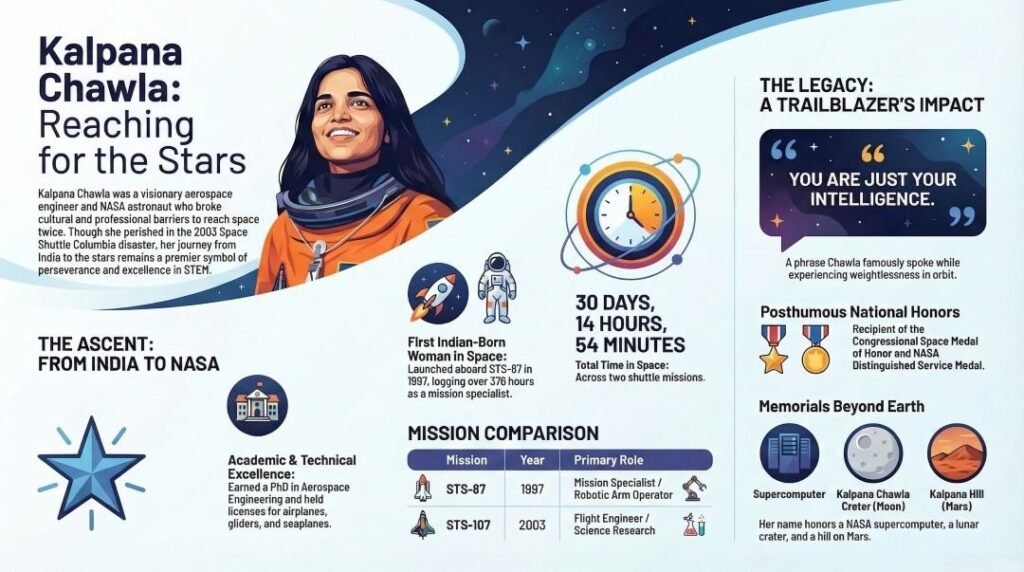
Kalpana Chawla flew in space twice – on STS-87 in 1997 and on STS-107 in 2003. The first mission made her famous; the second ended in tragedy. Here is a complete account of her time in space:
| Mission | Date | Details |
| STS-87 (First Mission) | 19 Nov – 5 Dec 1997 | Space Shuttle Columbia. Kalpana Chawla served as Mission Specialist and Primary Robotic Arm Operator. She operated the robotic arm to deploy the Spartan-201 solar observation satellite. The satellite did not deploy correctly and had to be retrieved by spacewalk – a malfunction that led to an official NASA investigation in which Chawla was cleared of any responsibility. She logged 376 hours, 34 minutes in space. She became the first woman of Indian origin to go to space and the first Indian-American woman in space. |
| STS-107 (Second and Final Mission) | 16 Jan – 1 Feb 2003 | Space Shuttle Columbia. A science research mission – 80 experiments conducted in 16 days including research in life sciences, fluid physics, combustion science, and atmospheric science. Mission duration: 15 days, 22 hours, 20 minutes. The mission ended in catastrophe when the shuttle disintegrated during re-entry on 1 February 2003. All seven crew members died. |
Kalpana Chawla’s Role in Space
- On STS-87, she served as Mission Specialist and Primary Robotic Arm Operator – a highly technical role involving the deployment and retrieval of satellites using the shuttle’s robotic arm system (the Canadarm)
- She was responsible for deploying the Spartan-201 solar observation satellite; when the satellite malfunctioned, she operated the robotic arm in an attempt to retrieve it – eventually two other crew members conducted a spacewalk to retrieve it manually; a NASA investigation cleared Chawla of any responsibility for the malfunction
- On STS-107, she served as Mission Specialist responsible for life sciences, physical sciences, and Earth/space sciences experiments conducted in the Spacehab Research Double Module
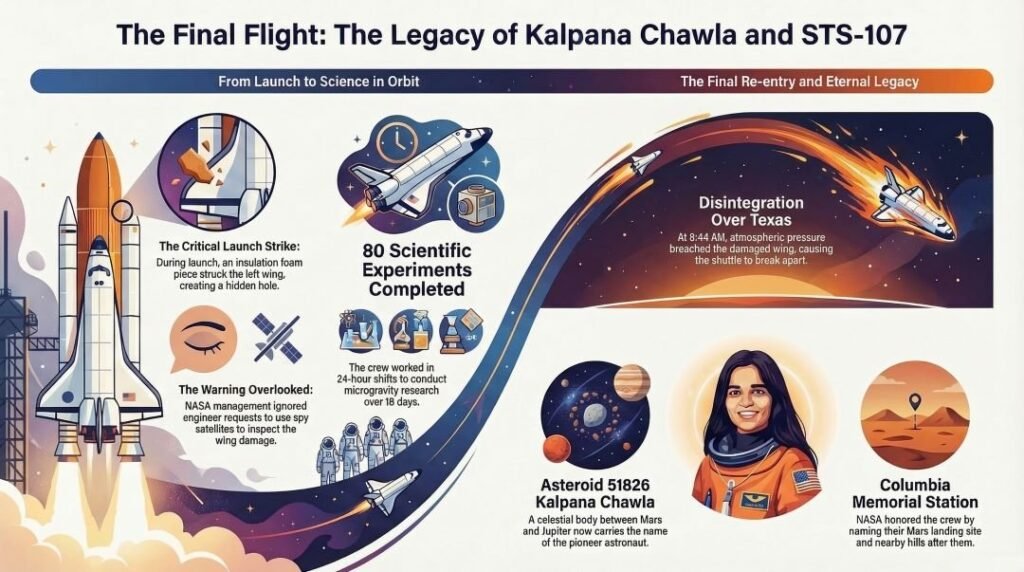
- The STS-107 crew conducted 80 scientific experiments during their 16 days in space – covering microgravity research, atmospheric science, combustion science, and life sciences
- She logged approximately 30 days, 14 hours, and 54 minutes in space across both missions
Kalpana Chawla Death: The Columbia Disaster
Kalpana Chawla died on 1 February 2003 – the date that every Indian who was alive at the time remembers with grief. She was 40 years old. Her death came in the Space Shuttle Columbia disaster – one of the most devastating events in the history of human spaceflight.
| Aspect | Detail |
| Date of Disaster | 1 February 2003 |
| Death Date | 1 February 2003 – during re-entry into Earth’s atmosphere |
| What Happened | The Space Shuttle Columbia broke apart during re-entry into Earth’s atmosphere approximately 16 minutes before its scheduled landing at Kennedy Space Center, Florida |
| Location of Disintegration | Over Texas and Louisiana in the southern United States – debris was scattered across a wide area |
| Cause | Damage to the thermal protection system (heat shield tiles) on the leading edge of the left wing – caused by a piece of foam insulation that broke off from the external tank during launch on 16 January 2003 and struck the wing at high speed |
| The Crew | All 7 crew members died: Rick Husband (Commander), William McCool (Pilot), Michael Anderson, Ilan Ramon (first Israeli astronaut), David Brown, Laurel Clark, and Kalpana Chawla (Mission Specialist) |
| Kalpana Chawla’s Role on STS-107 | Mission Specialist; responsible for microgravity science experiments, life sciences research, and Earth/space science experiments; overseeing the science mission in the Spacehab Research Double Module |
| Kalpana Chawla’s Final Words (Recorded) | There is no verified record of her specific final words. The crew were in normal communication with Mission Control up to approximately 8:54 AM EST on 1 February 2003, just before the disaster began. |
| Investigation | The Columbia Accident Investigation Board (CAIB) conducted a thorough investigation. The report found that both technical failures and organisational failures at NASA contributed to the disaster. |
| Impact on India | The news of Kalpana Chawla’s death was received with profound grief across India. She had become a national hero – particularly for her significance as the first woman of Indian origin in space and as a symbol for young Indian women aspiring to careers in science and technology. |
How Did Kalpana Chawla Die? (In Detail)
On 16 January 2003, the Space Shuttle Columbia launched from Kennedy Space Center in Florida on mission STS-107. Approximately 81.7 seconds after launch, a piece of foam insulation broke off from the bipod ramp of the external fuel tank and struck the leading edge of Columbia’s left wing at high speed. This impact damaged the reinforced carbon-carbon panels on the wing’s leading edge – the thermal protection system that prevents the shuttle from being destroyed by the intense heat of re-entry.
The foam strike was observed on launch video, and engineers at NASA raised concerns about potential damage during the mission. However, NASA management decided that even if damage had occurred, there was little that could be done during the mission, and the decision was made not to investigate further during the flight. This decision would later be identified by the Columbia Accident Investigation Board as a catastrophic failure of NASA’s organisational culture.
On 1 February 2003, as the Columbia began re-entry into Earth’s atmosphere on its way home, superheated atmospheric gases entered the damaged section of the left wing through the breach created by the foam strike. Within minutes, the structural integrity of the wing was destroyed. At approximately 8:59 AM Eastern Standard Time, the shuttle broke apart over Texas and Louisiana. All seven crew members – including Kalpana Chawla – died instantly.
The debris field was scattered over an enormous area of Texas and Louisiana. Recovery teams spent months collecting the remains of the crew and the wreckage of the shuttle. The crew’s remains were eventually returned to their families for burial.
Kalpana Chawla Achievements and Awards Won
Kalpana Chawla’s achievements were extraordinary – both as a pioneer in space exploration and as a symbol for Indian women in science and engineering. Here is a complete record of the awards won by Kalpana Chawla and the honours established in her memory:
| Achievement / Award | Detail |
| First Woman of Indian Origin in Space | On 19 November 1997, when STS-87 launched, Kalpana Chawla became the first woman of Indian origin and the first Indian-American woman to go to space – a historic milestone for India and for all Indian women in science |
| Congressional Space Medal of Honor | Awarded posthumously by President George W. Bush – the highest award given by the US government to astronauts |
| NASA Space Flight Medal | Awarded for both STS-87 and STS-107 missions |
| NASA Distinguished Service Medal | Awarded posthumously in recognition of her exceptional service to NASA and to human spaceflight |
| Padma Vibhushan | India’s second-highest civilian honour – awarded posthumously by the Government of India in recognition of her extraordinary achievement and her significance as a symbol of Indian scientific aspiration |
| Kalpana Chawla Award | The Karnataka state government established the Kalpana Chawla Award – given annually to recognise outstanding women scientists in India |
| NASA Satellite Named After Her | The United States named a NASA Cygnus spacecraft (NG-14) after Kalpana Chawla – the spacecraft launched in 2020 to carry supplies to the International Space Station |
| Punjab Engineering College (Chandigarh) | The girls’ hostel at her alma mater Punjab Engineering College is named after Kalpana Chawla – a permanent tribute at the institution where her journey to space began |
| University of Texas Arlington | A department at the University of Texas at Arlington – where she completed her Master’s degree – is named in her honour |
| Schools, Roads, and Institutions | Hundreds of schools, roads, planetariums, and public institutions across India – particularly in Haryana – have been named after Kalpana Chawla in recognition of her legacy |
| Jyotiramayi Award (Andhra Pradesh) | Various state-level awards in her memory across Indian states |
Kalpana Chawla’s Legacy: How She Changed India
It is difficult to overstate the impact that Kalpana Chawla had on India – and continues to have, more than two decades after her death. She arrived at a moment when Indian women in science and technology faced enormous social barriers. She transcended those barriers through sheer talent, determination, and courage, and in doing so she redefined what was possible for the generation of Indian girls who watched her reach space.
- She showed that a girl from a small city in Haryana – from a country where few women pursued engineering – could reach the highest levels of achievement in the most demanding field of science
- Her name was given to hundreds of schools, roads, and institutions across India – particularly in Haryana – ensuring that her story would be told to each new generation
- She became a symbol in the Indian educational system: her biography is included in school textbooks; her story is the subject of CTET, UPSC, and other examination questions
- The Kalpana Chawla Award – given by the Karnataka state government to outstanding women scientists – ensures that her name is permanently linked to the advancement of women in Indian science
- NASA named a Cygnus spacecraft after her in 2020 – ensuring that her name literally travelled through space again, seventeen years after her death
- She inspired a generation of Indian women to pursue careers in STEM – her influence on India’s engineering and space programmes is immeasurable
Kalpana Chawla and Sunita Williams – Clarification
A common area of confusion in online searches is the relationship between Kalpana Chawla and Sunita Williams. To be completely clear: they are two different people. Kalpana Chawla (1962–2003) was the first woman of Indian origin to go to space, flying on STS-87 in 1997 and dying in the STS-107 Columbia disaster in 2003. Sunita Williams (born 1965) is a separate American astronaut of Indian descent who was not part of the Columbia mission; she is famous for spending 322 days in space across her missions. Both women are heroes – but they are entirely different people, and Kalpana Chawla’s sister is named Sunita Chawla (not Sunita Williams).
Kalpana Chawla CTET and EVS Reference
Kalpana Chawla is a key topic in CTET (Central Teacher Eligibility Test) Environmental Studies (EVS) for Classes I-V. She appears regularly in both Paper 1 (for Classes I–V teachers) and Paper 2. Below is a comprehensive MCQ reference covering all the ways she appears in examination questions:
| Question | Answer |
| Kalpana Chawla was born in which city? | Karnal, Haryana, India |
| What was Kalpana Chawla’s first space mission? | STS-87 (Space Shuttle Columbia), launched 19 November 1997 |
| What was Kalpana Chawla’s role in STS-87? | Mission Specialist and Primary Robotic Arm Operator |
| In which year did Kalpana Chawla die in the space shuttle? | 2003 (1 February 2003) – Option 4 in the CTET MCQ |
| What was the name of the space shuttle that caused her death? | Space Shuttle Columbia (STS-107) |
| Why did the Space Shuttle Columbia disaster happen? | Foam insulation from the external tank struck the left wing during launch, damaging the thermal protection system; the shuttle broke apart during re-entry |
| Where did Kalpana Chawla complete her bachelor’s degree? | Punjab Engineering College (PEC), Chandigarh – Bachelor of Engineering in Aeronautical Engineering (1982) |
| Where did she complete her Master’s degree? | University of Texas at Arlington, USA – MSc in Aerospace Engineering (1984) |
| When was she selected for the NASA astronaut corps? | March 1995 |
| What is Kalpana Chawla’s historic distinction? | First woman of Indian origin to go to space; first Indian-American woman in space |
| Who is Sunita Williams? (often confused with Kalpana Chawla) | Sunita Williams is a different astronaut of Indian descent who spent 322 days in space – she is NOT Kalpana Chawla; they are two different people |
| Did Kalpana Chawla have children? | No – Kalpana Chawla had no children |
| What award was given to Kalpana Chawla posthumously by India? | Padma Vibhushan – India’s second-highest civilian honour |
| What is the Kalpana Chawla Award? | An award given by the Karnataka state government to recognise outstanding women scientists in India |
Why Kalpana Chawla Is Important for CTET EVS
- She is described in the NCERT EVS textbook as an example of a person who broke barriers – relevant to the EVS themes of gender equality, women’s achievements, and inspiration
- She represents the theme of scientific achievement and space exploration in the EVS curriculum
- She is used in CTET questions about famous Indians, about space missions, and about role models for children
- The AI Overview in Google’s search results specifically identifies her as ‘a key figure for CTET EVS (Environmental Studies)’ and as ‘a trailblazer for women in science, originating from a small town in India’
- Key CTET facts to remember: Born in Karnal (not Delhi, not Chandigarh); Bachelor’s from Punjab Engineering College; first woman of Indian origin in space; died 1 February 2003 in Columbia disaster (year: 2003)
Kalpana Chawla Timeline: Complete Life Story
| Year | Key Event |
| 1962 | Born on 17 March in Karnal, Haryana, India, to Banarasi Lal Chawla and Sanjyothi Chawla |
| 1976 | Completed schooling at Tagore Baal Niketan Senior Secondary School, Karnal |
| 1982 | Graduated with a BE in Aeronautical Engineering from Punjab Engineering College (PEC), Chandigarh |
| 1982 | Moved to the United States to pursue higher education in aerospace engineering |
| 1983 | Married Jean-Pierre Harrison – a flying instructor and aviation writer |
| 1984 | Received Master of Science in Aerospace Engineering from the University of Texas at Arlington |
| 1988 | Received PhD in Aerospace Engineering from the University of Colorado Boulder; joined NASA Ames Research Center as a researcher in computational fluid dynamics |
| 1991 | Became a naturalised United States citizen |
| 1994 | Applied to the NASA astronaut programme |
| March 1995 | Selected for the NASA Astronaut Corps – one of 15 selected from over 2,962 applicants |
| 1996 | Completed astronaut training; selected for her first space mission STS-87 |
| 19 Nov 1997 | FIRST SPACE MISSION: STS-87 launched – Kalpana Chawla became the first woman of Indian origin in space; logged 376 hours in space |
| 5 Dec 1997 | STS-87 landed – mission completed successfully |
| 2000 | Assigned to the crew of STS-107 – her second and final space mission |
| 16 Jan 2003 | SECOND SPACE MISSION: STS-107 launched from Kennedy Space Center, Florida |
| 1 Feb 2003 | DEATH: Space Shuttle Columbia disintegrated during re-entry over Texas at 8:59 AM EST – all seven crew members died; Kalpana Chawla was 40 years old |
| 2003 onwards | Posthumous awards: Congressional Space Medal of Honor, NASA Distinguished Service Medal, Padma Vibhushan; numerous institutions named after her across India and the USA |
| 2020 | NASA named a Cygnus spacecraft (NG-14) after Kalpana Chawla – it carried supplies to the International Space Station |
Biography of Kalpana Chawla in English (Short – For Students)
Kalpana Chawla (17 March 1962 – 1 February 2003) was an Indian-American astronaut and aerospace engineer born in Karnal, Haryana, India. She was the first woman of Indian origin to go to space. Daughter of Banarasi Lal Chawla and Sanjyothi Chawla, she studied aeronautical engineering at Punjab Engineering College, Chandigarh, before moving to the United States to earn a Master’s degree (University of Texas, Arlington, 1984) and a PhD (University of Colorado Boulder, 1988) in aerospace engineering. She married Jean-Pierre Harrison in 1983 and became a US citizen in 1991.
She joined the NASA Astronaut Corps in March 1995. Her first space mission was STS-87 (November–December 1997) aboard the Space Shuttle Columbia, on which she served as Mission Specialist and Primary Robotic Arm Operator. Her second and final mission was STS-107 (January–February 2003). On 1 February 2003, the Space Shuttle Columbia disintegrated during re-entry over Texas, killing all seven crew members. She was 40 years old. She was posthumously awarded the Congressional Space Medal of Honor and India’s Padma Vibhushan. Hundreds of institutions, roads, and awards across India and the USA bear her name.
Kalpana Chawla ka Jivan Parichay (For Hindi-Medium Readers)
Kalpana Chawla ka janm 17 March 1962 ko Karnal, Haryana mein hua tha. Ve ek Indian-American astronaut aur aerospace engineer thi. Unke pita ka naam Banarasi Lal Chawla aur mata ka naam Sanjyothi Chawla tha. Unhone apni schooling Tagore Baal Niketan Senior Secondary School, Karnal se ki. Phir unhone Punjab Engineering College, Chandigarh se Aeronautical Engineering mein BE ki. Baad mein ve Amerika gayi jahan unhone University of Texas, Arlington se MSc aur University of Colorado Boulder se PhD aerospace engineering mein ki. 1983 mein unhone Jean-Pierre Harrison se vivah kiya. 1995 mein ve NASA astronaut corps mein select hui. 19 November 1997 ko unhone apni pehli antariksh yatra (STS-87) ki aur antariksh mein jane wali pehli Indian origin mahila bani. 1 February 2003 ko Space Shuttle Columbia disaster mein unka nidhan ho gaya. Bharat sarkar ne unhe mrityu uparant Padma Vibhushan se sammanit kiya.
10 Lines About Kalpana Chawla for Students
- Kalpana Chawla was born on 17 March 1962 in Karnal, Haryana, India, to Banarasi Lal Chawla and Sanjyothi Chawla.
- She studied aeronautical engineering at Punjab Engineering College, Chandigarh, and later earned a PhD in aerospace engineering from the University of Colorado Boulder, USA.
- She married Jean-Pierre Harrison – a flying instructor and aviation writer – in 1983.
- She was selected for the NASA Astronaut Corps in March 1995, one of 15 selected from nearly 3,000 applicants.
- On 19 November 1997, she became the first woman of Indian origin to go to space, flying on the Space Shuttle Columbia (STS-87).
- On her first mission STS-87, she served as Mission Specialist and Primary Robotic Arm Operator, logging 376 hours in space.
- Her second mission, STS-107, launched on 16 January 2003 and conducted 80 scientific experiments over 16 days in space.
- She died on 1 February 2003 when the Space Shuttle Columbia disintegrated during re-entry into Earth’s atmosphere – all seven crew members were killed.
- She was posthumously awarded the Congressional Space Medal of Honor (USA) and the Padma Vibhushan (India’s second-highest civilian honour).
- She remains one of India’s greatest heroes – hundreds of schools, roads, awards, and institutions across India and the USA bear her name, and NASA named a spacecraft in her honour in 2020.
Conclusion: The Star That Never Fades
Kalpana Chawla lived for forty years, flew in space for about thirty days, and has inspired hundreds of millions of people for the more than twenty years since her death. That ratio – the scale of her influence compared to the brevity of her life – is perhaps the most striking thing about her story.
She came from Karnal. She dreamed of the stars. She worked harder than almost anyone around her. She overcame every obstacle that a society, an education system, and a profession could put in the way of a girl from a small Indian city who wanted to go to space. And then she went. Twice. And the second time, she did not come back.
But what she left behind is something no disaster can destroy: the knowledge that it is possible. Possible for a girl from Haryana, from India, from anywhere, to reach the stars. Every young Indian woman who studies engineering today, who applies to the Indian Space Research Organisation, who looks up at the night sky and feels that ancient, irresistible pull – she carries Kalpana Chawla’s story with her, whether she knows it or not.
Also read: [Update] Al-Biruni Biography PDF and PPT Download (.PPTX)
Final Quick Reference – Kalpana Chawla Key Facts
- Full Name: Kalpana Chawla
- Born: 17 March 1962 – Karnal, Haryana, India
- Died: 1 February 2003 – Space Shuttle Columbia disaster, during re-entry over Texas
- Death Age: 40 years
- Death Date: 1 February 2003 (CTET answer: 2003)
- Cause of Death: Space Shuttle Columbia disintegrated during re-entry – foam insulation strike damaged left wing heat shield
- Parents: Father – Banarasi Lal Chawla; Mother – Sanjyothi Chawla
- Husband: Jean-Pierre Harrison (married 1983) – flying instructor and aviation writer
- Children: None
- Education: PEC Chandigarh (BE Aeronautical Engg, 1982); UT Arlington (MSc, 1984); Univ Colorado (PhD, 1988)
- NASA Selected: March 1995
- First Space Mission: STS-87 – 19 November 1997 (first woman of Indian origin in space)
- Second Mission: STS-107 – 16 January 2003
- Total Time in Space: ~30 days, 14 hours, 54 minutes
- Historic Achievement: First woman of Indian origin to go to space
- Awards: Congressional Space Medal of Honor; Padma Vibhushan; NASA Distinguished Service Medal; Kalpana Chawla Award (Karnataka)
- Named After Her: NASA Cygnus spacecraft (2020); PEC girls’ hostel; UT Arlington department; hundreds of schools and roads
- CTET Key Fact: Born in Karnal; bachelor’s from Punjab Engineering College; died in Columbia disaster in 2003
- Sunita Williams: A DIFFERENT person – she spent 322 days in space but is NOT Kalpana Chawla
![[Update] Al-Biruni Biography PDF and PPT Download (.PPTX)](https://sachinacademy.in/wp-content/uploads/2026/03/Update-Al-Biruni-Biography-PDF-and-PPT-Download-1-1024x559.jpg "[Update] Al-Biruni Biography PDF and PPT Download (.PPTX) 8")